MAY 2026
The Heart Rhythm Center scientific team has advanced clinical electrophysiology research by publishing their latest findings in the Journal of Cardiovascular Electrophysiology, a highly respected and leading peer-reviewed international journal dedicated to cardiac arrhythmia management.
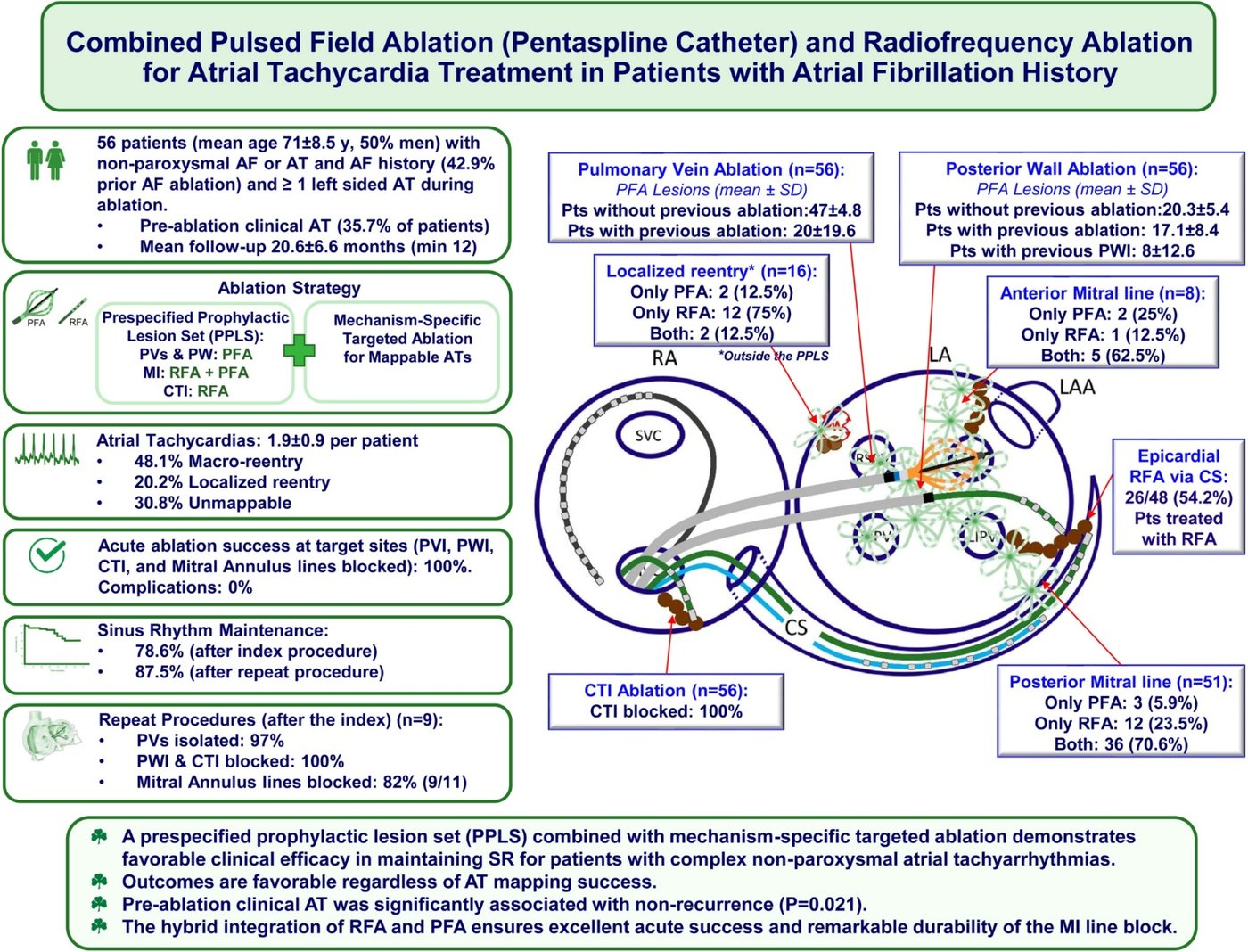
The focus of this study is the evaluation of a prespecified prophylactic lesion set (PPLS) combined with targeted mapping to address coexisting atrial tachycardias (ATs) encountered during or after atrial fibrillation (AF) ablation. This approach was implemented in a cohort of 56 consecutive patients presenting with non-paroxysmal AF or AT and a history of AF. The intervention protocol comprised pulmonary vein isolation and left atrial posterior wall ablation utilizing pulsed-field ablation (PFA) via a pentaspline catheter, a hybrid radiofrequency (RF) and PFA approach for the mitral isthmus line, and conventional RF ablation for the cavotricuspid isthmus.
Our clinical data confirmed the reliability of this method, recording a 100% acute procedural success rate across all ablation target sites. Over a mean follow-up period of 20.6 months, 87.5% of patients maintained a stable sinus rhythm following the final intervention. Concurrently, in cases requiring repeat evaluation, the created lesion lines demonstrated exceptional chronic durability over time, achieving a 97.2% permanence rate for pulmonary veins and 89% for the mitral isthmus. This comprehensive approach proved to be highly effective, ensuring elevated arrhythmia-free survival rates within a particularly demanding cardiac substrate.
The publication was co-authored by the center’s electrophysiologists and clinical associates, D. Gerontitis, V. Tsonona, P. Charalambopoulos, D. Samara, A. Vassilopoulos, K. Kouvelas, E. Christoforatou, and D. Katsaras, alongside the Director of the Heart Rhythm Center, P. Ioannidis, further strengthening the department’s continuous research presence in the global medical community.
Visit the link:
https://doi.org/10.1111/jce.70389