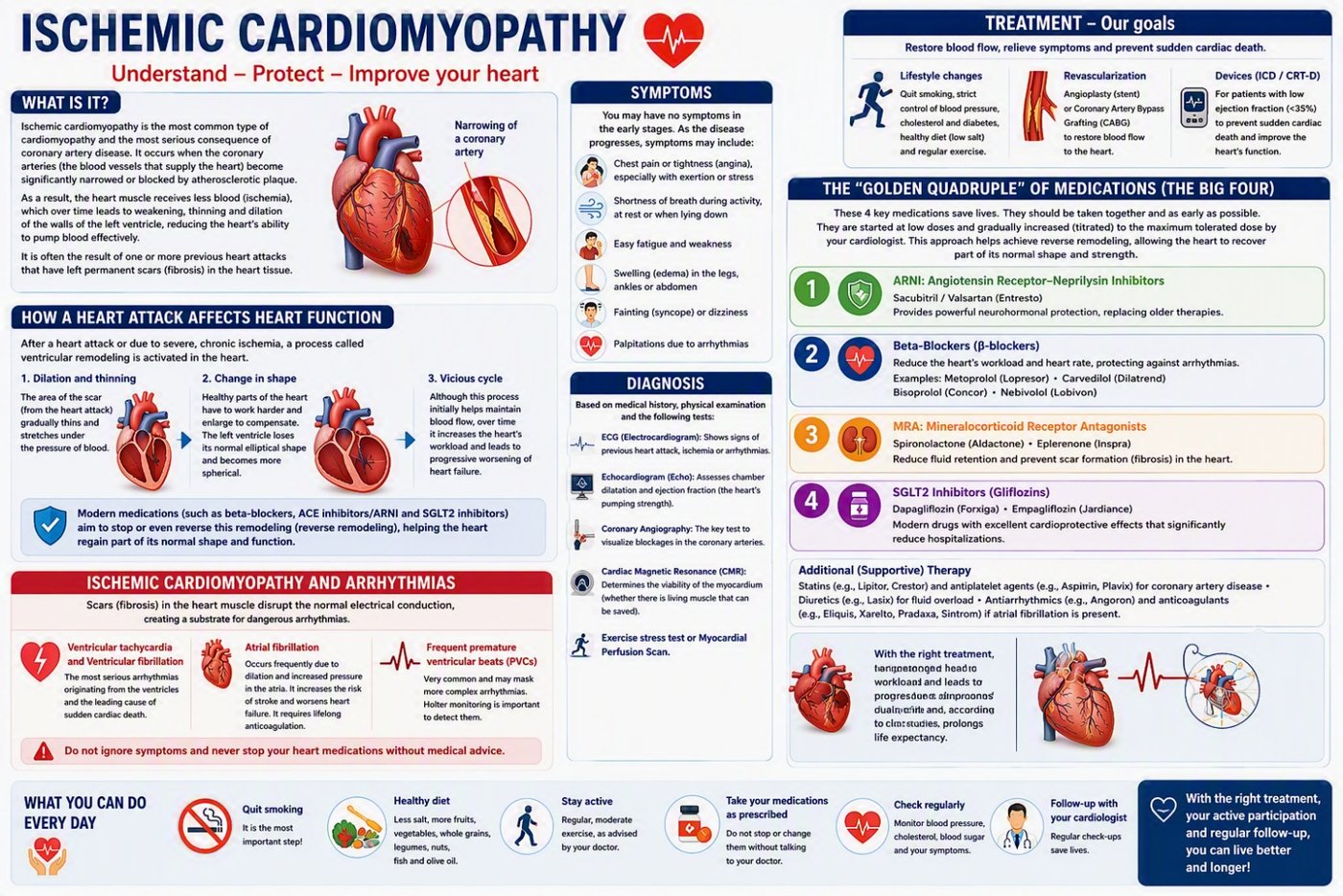
Definition
Ischemic cardiomyopathy (ICM) is the most prevalent form of cardiomyopathy and represents the most severe consequence of coronary artery disease (CAD). It occurs when the coronary arteries (the vessels supplying blood to the myocardium) develop significant stenosis or occlusion due to atherosclerotic plaque accumulation. This leads to reduced blood flow (ischemia) to the myocardium, which progressively causes weakening, thinning, and dilation of the left ventricular walls, ultimately impairing the heart’s ability to pump blood effectively. It is frequently the long-term consequence of one or more prior myocardial infarctions (heart attacks) that have left permanent scars (fibrosis) within the cardiac tissue.
The Impact of Infarction on Cardiac Function
Following a myocardial infarction or due to severe, chronic ischemia, a pathophysiological process known as ventricular remodeling is initiated within the heart. This represents an adaptive mechanism by the myocardium trying to compensate for the function of cells that have been destroyed or are dysfunctional.
During this process:
- Dilation and Thinning: The scarred (infarcted) area progressively thins out and stretches (dilates) under hemodynamic pressure.
- Structural Alteration: To compensate for the loss of contractile strength, the healthy segments of the myocardium undergo compensatory hypertrophy and enlargement. Consequently, the left ventricle loses its normal ellipsoid shape and becomes more spherical.
- Vicious Cycle: Although ventricular remodeling initially helps maintain cardiac output, over the long term, it increases cardiac workload and stress, leading to a progressive worsening of heart failure.
Modern pharmacological therapy (such as beta-blockers, ACE inhibitors/ARNIs, and SGLT2 inhibitors) specifically aims to halt or even reverse this process (reverse remodeling), helping the heart regain part of its physiological geometry and functional capacity.
Symptoms
Many patients may remain asymptomatic during the early stages of the disease; however, as the condition progresses, symptoms of heart failure and ischemia manifest:
- Chest pain or pressure (angina), primarily triggered by exertion or stress.
- Dyspnea (shortness of breath) during exertion, or even at rest/in the supine position (orthopnea).
- Fatigue, exercise intolerance, and generalized weakness.
- Peripheral edema (swelling) in the legs, ankles, or abdomen (ascites).
- Syncope (fainting) or lightheadedness.
- Palpitations due to cardiac arrhythmias.
Diagnosis
Diagnosis is established based on medical history, physical examination, and a series of diagnostic investigations:
- Electrocardiogram (ECG/EKG): Identifies signs of a prior myocardial infarction, active ischemia, or arrhythmias.
- Echocardiogram (Cardiac Triplex): Assesses chamber dilation and evaluates the Left Ventricular Ejection Fraction (LVEF), which measures the heart’s contractile strength.
- Coronary Angiography (Cardiac Catheterization): The definitive gold-standard diagnostic modality to visualize stenoses within the coronary arteries.
- Cardiovascular Magnetic Resonance (CMR): Determines myocardial viability by identifying viable (hibernating) myocardium that could potentially benefit from revascularization.
- Exercise Stress Testing or Myocardial Perfusion Scintigraphy (SPECT).
Ischemic Cardiomyopathy and Arrhythmias
Myocardial regions affected by infarction or chronic ischemia transform into scar tissue (fibrosis). These fibrotic areas disrupt normal cardiac electrical conduction, creating the ideal substrate for dangerous re-entrant arrhythmias:
- Ventricular Tachycardia (VT) and Ventricular Fibrillation (VF): These are life-threatening arrhythmias originating in the ventricles and constitute the leading cause of Sudden Cardiac Death (SCD) in this patient population.
- Atrial Fibrillation (AF): Frequently occurs due to dilation and elevated filling pressures within the atria, significantly increasing the risk of thromboembolic stroke and exacerbating heart failure symptoms. This condition necessitates mandatory oral anticoagulation therapy.
- Premature Ventricular Contractions (PVCs): Highly prevalent, requiring ambulatory ECG monitoring (Holter monitor) to screen for more complex ventricular arrhythmias.
Treatment
Therapeutic management aims to restore myocardial perfusion, alleviate clinical symptoms, and prevent sudden cardiac death:
- Lifestyle Modifications: Smoking cessation, strict management of hypertension, hyperlipidemia, and diabetes mellitus, a heart-healthy low-sodium diet, and supervised, tailored exercise training.
- Pharmacological Therapy: Guideline-Directed Medical Therapy (GDMT) forms the cornerstone of managing ischemic cardiomyopathy. These agents do not merely relieve daily symptoms but directly intervene in pathophysiological pathways to protect the myocardium, prevent malignant arrhythmias, and drastically reduce heart failure-related hospitalizations.
At the core of this strategy is the "Fantastic Four" (historically referenced as the Golden Quadruplet or The Big Four). This is an evidence-based combination of four specific drug classes that work synergistically. They should be initiated concurrently and as early as possible post-diagnosis. Treatment typically begins at low doses, which are progressively up-titrated by the attending cardiologist at regular intervals to the maximum tolerated target doses. This optimization induces reverse remodeling, helping the heart recover part of its structural geometry and systolic function.
The four pillars of GDMT consist of:
- Angiotensin Receptor-Neprilysin Inhibitors (ARNI): Sacubitril/Valsartan (commercially available in Greece as Entresto). It provides potent neurohormonal blockade and serves as a preferred replacement for traditional ACE inhibitors.
- Beta-blockers (β-blockers): Reduce myocardial workload, decrease heart rate, and protect against ventricular arrhythmias. Commonly utilized agents include Metoprolol (Lopresor), Carvedilol (Dilatrend), Bisoprolol (Concor), and Nebivolol (Lobivon).
- Mineralocorticoid Receptor Antagonists (MRA): Spironolactone (Aldactone) or Eplerenone (Inspra). These agents reduce fluid retention and inhibit adverse myocardial remodeling and fibrosis.
- SGLT2 Inhibitors (Gliflozins): Dapagliflozin (Forxiga) or Empagliflozin (Jardiance). These modern agents provide significant cardioprotection and lower the risk of cardiovascular mortality and heart failure hospitalizations.
- Adjunctive Pharmacotherapy: This primary regimen is supplemented by statins (e.g., Lipitor, Crestor) and antiplatelet agents (e.g., Salospil, Plavix) for underlying CAD; loop diuretics (e.g., Lasix) for volume decongestion; antiarrhythmics (e.g., Angoron / Amiodarone); and oral anticoagulants (e.g., Eliquis, Xarelto, Pradaxa, Sintrom) if concurrent Atrial Fibrillation is present.
- Revascularization: Percutaneous Coronary Intervention (PCI with balloon angioplasty/stent placement) or Coronary Artery Bypass Grafting (CABG) surgery to restore adequate myocardial blood supply.
- Implantable Cardioverter-Defibrillator (ICD) or Cardiac Resynchronization Therapy Defibrillator (CRT-D): Strongly indicated in patients with severely reduced ejection fraction (typically LVEF ≤ 35%) for the primary or secondary prevention of sudden cardiac death and the improvement of cardiac synchronization.
- Atrial Fibrillation Ablation: For patients with symptomatic AF—which compromises hemodynamic function and decreases the efficacy of heart failure medical therapy—catheter ablation offers an effective intervention. The procedure aims for the electrical isolation of the pulmonary veins to restore and maintain normal sinus rhythm. This intervention provides significant symptom relief, enhances quality of life, and clinical data suggest it may improve long-term survival outcomes.