
Brand names: Biocoryl, Pronestyl
It is a Class Ia antiarrhythmic drug administered primarily via the intravenous (IV) route. Much like quinidine, it can accelerate conduction through the atrioventricular (AV) node.
Indications
- Procainamide is indicated for the management of supraventricular and ventricular arrhythmias, following clinical indications similar to those of quinidine.
- It can be utilized for the cardioversion of recent-onset atrial fibrillation.
- Due to its properties in slowing conduction through accessory pathways, it can be employed for the termination of reentrant tachycardias utilizing these pathways, and primarily for the rate control or termination of atrial fibrillation coexisting with an accessory pathway (e.g., Wolff-Parkinson-White syndrome).
- It can be used for the acute cardioversion of ventricular tachycardia.
- During electrophysiology studies (EPS), it is used to evaluate cardiac conduction downstream of the AV node, functioning as a pharmacological stress test. If a significant prolongation of the conduction time (HV interval) is observed, this finding, combined with clinical presentation, can support the indication for permanent pacemaker implantation.
- Intravenous procainamide is utilized as a provocative challenge for the diagnosis of Brugada syndrome. The test is considered positive if it induces the characteristic Type I Brugada electrocardiographic (ECG) pattern.
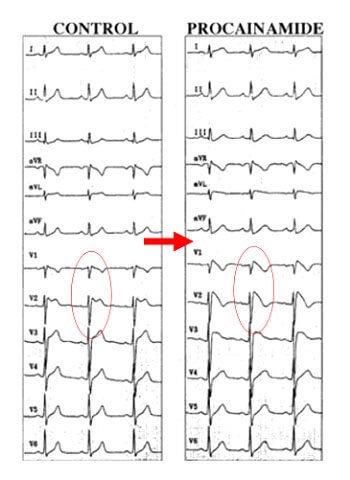
Positive drug challenge test showing ECG conversion to the diagnostic Type I Brugada pattern.
Adverse Effects
- Gastrointestinal disturbances.
- In patients with pre-existing impaired infra-nodal conduction, procainamide administration can precipitate high-grade or complete atrioventricular block.
- QT interval prolongation and Torsades de Pointes.
- Chronic administration can cause arthralgia, fever, pleuritis, pericarditis, and hepatomegaly, presenting as a drug-induced systemic lupus erythematosus (SLE)-like syndrome.