
Definition
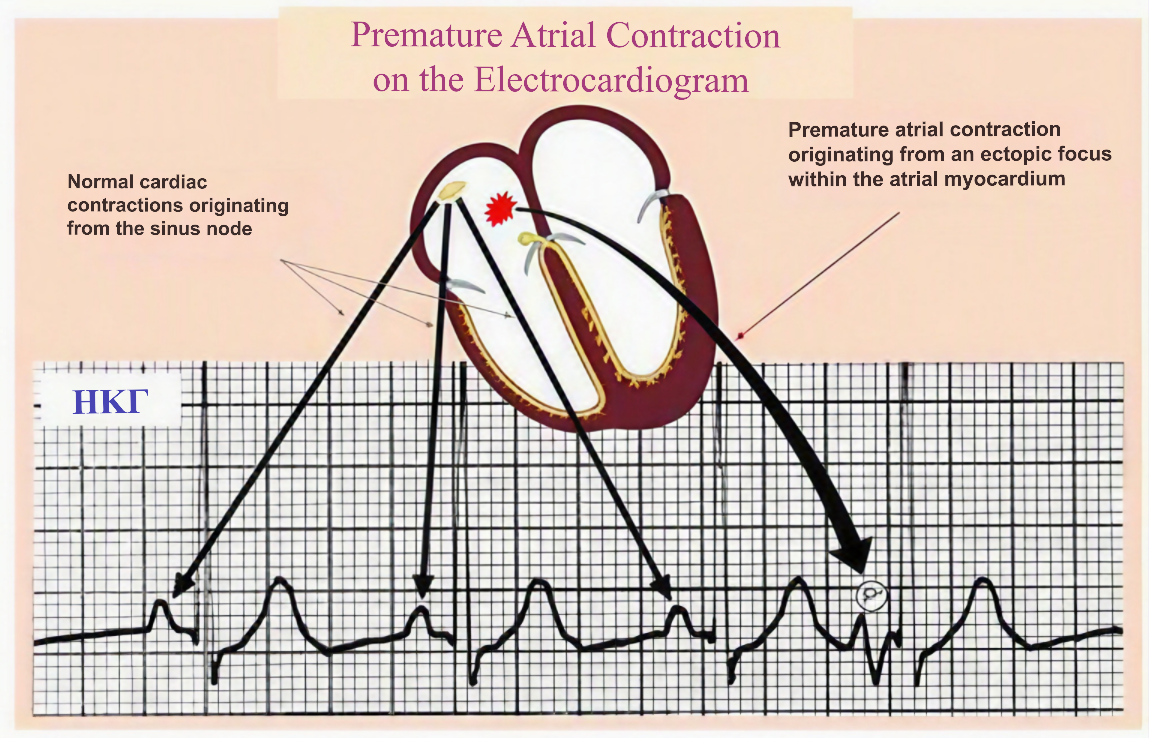
Premature Atrial Contractions (PACs) are isolated, premature cardiac contractions originating from the atria. They intersperse transiently and potentially recurrently within the normal sinus rhythm.
- Atrial Bigeminy: A pattern where every normal sinus contraction is followed by a premature contraction.
- Atrial Trigeminy: A pattern where a premature contraction occurs after every two consecutive normal sinus beats.
PACs constitute a highly prevalent clinical phenomenon. Patients frequently perceive them as brief pauses or forceful palpitations, often described as a "fluttering" sensation in the chest.
Clinical Significance
In the vast majority of cases, PACs represent a benign electrocardiographic finding requiring no further diagnostic investigation.
However, they can also manifest in patients with structural heart disease. Examples include left atrial enlargement, heart failure, and valvular heart disease. In asymptomatic patients, targeted intervention for PACs is not indicated; management should focus exclusively on treating the underlying cardiovascular disease. Additionally, patients with pulmonary diseases frequently exhibit a high burden of PACs due to increased workload and strain on the right side of the heart, specifically the right atrium.
In certain instances, PACs in patients with paroxysmal atrial fibrillation (AF) can reveal the underlying arrhythmogenic mechanism, as they often originate from the focal triggers that initiate AF episodes. Furthermore, in hearts predisposed to other arrhythmias—such as atrial flutter, atrioventricular nodal reentrant tachycardia (AVNRT), or accessory pathway-mediated tachycardia—a high density of PACs can trigger the reentrant circuit. In this context, they may serve as precursors to sustained tachyarrhythmias.
Symptomatology
- Asymptomatic presentation: PACs are most frequently asymptomatic.
- Palpitations: They can be perceived as brief pauses or "fluttering" sensations. This occurs because the premature contraction is early, leading to incomplete ventricular filling and a reduced stroke volume. Consequently, during the subsequent normal sinus beat, the increased end-diastolic volume results in a more forceful ventricular contraction, which is often palpable to the patient.
- Hemodynamic effects: When PACs present in a bigeminal pattern (one normal beat followed by one premature beat), the condition can mimic bradycardia. This may cause symptoms of weakness and dizziness, particularly in elderly individuals. This occurs because the premature contraction yields a minimal stroke volume that fails to generate a palpable peripheral pulse (ineffective contraction). Notably, during blood pressure measurement with electronic sphygmomanometers, the recorded pulse rate may appear at half of the actual rate (e.g., 30 beats per minute instead of 60).
Etiology
Given that PACs are a ubiquitous finding, they typically do not imply an underlying pathological condition. Other potential etiologies include:
- Anxiety and stress.
- Excessive caffeine consumption.
- Established structural heart disease (e.g., coronary artery disease, valvular disease, heart failure).
- Pulmonary disease (e.g., Chronic Obstructive Pulmonary Disease – COPD, bronchial asthma).
- Medication abuse or overconsumption (sympathomimetics, beta-agonists).
- Drug toxicity (e.g., Digoxin).
Diagnostic Evaluation
PACs are easily diagnosed via a standard 12-lead electrocardiogram (ECG) or Holter monitor. When structural heart disease is suspected based on concurrent clinical findings, an appropriate diagnostic workup must be initiated.
Management
- Conservative approach: In most cases, no specific therapeutic intervention is required.
- Pharmacotherapy: For symptomatic cases, beta-blockers or other antiarrhythmic agents may be prescribed.
- Interventional therapy: In rare instances where a high burden of PACs causes intolerable symptoms, catheter ablation of the arrhythmogenic focus within the atrial myocardium may be indicated.