
Introduction
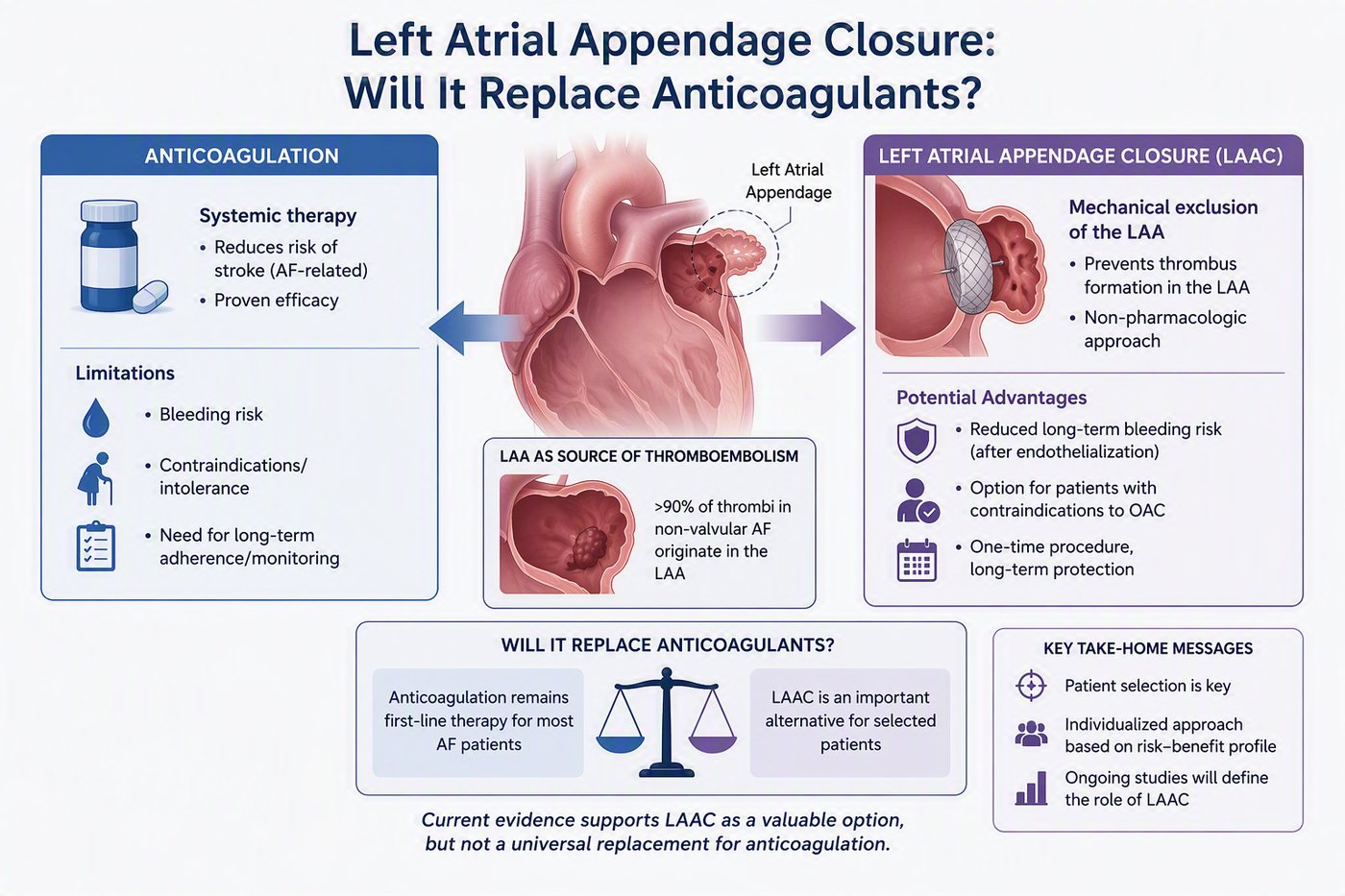
The prevention of ischemic stroke in patients with atrial fibrillation (AF) is fundamentally based on direct oral anticoagulants (DOACs), which have radically transformed the therapeutic landscape. Despite their efficacy, bleeding risk remains the primary limiting factor for their long-term use. Percutaneous left atrial appendage closure (LAAC) was developed as a focused, non-pharmacological solution, grounded in the fact that over 90% of thrombi in non-valvular AF originate within the appendage. While this method provides an irreplaceable solution for selected patient populations, current scientific debate centers on whether LAAC can serve as a universal alternative to DOACs.
 Clinical Data: From Non-Inferiority to Contemporary Trials
The initial approval of LAAC devices was based on the historical PROTECT-AF and PREVAIL trials [1], which demonstrated non-inferiority compared to warfarin. The PRAGUE-17 trial [2,3] marked a milestone as the first randomized study to compare LAAC directly with DOACs in high-risk patients, demonstrating similar rates in composite clinical endpoints while highlighting the persistent challenge of procedural complications. More recently, the OPTION trial (2024) [4] compared LAAC to oral anticoagulants (OAC) in patients undergoing atrial fibrillation ablation, showing that the device achieved its primary efficacy endpoint. Furthermore, the ongoing CHAMPION-AF [5] trial is evaluating next-generation closure devices against DOACs in broader patient populations.
However, interpreting these results requires careful scrutiny. Current critical reviews of international literature indicate that widespread enthusiasm for routine LAAC use is not entirely justified by the available data. Many of these trials utilize wide non-inferiority margins and composite endpoints that facilitate achieving the primary target, often lacking the statistical power needed to demonstrate clear differences in ischemic stroke rates.
Corroborating this caution, the CLOSURE-AF trial [6] offered a sobering reality: in patients at very high risk for both stroke and bleeding, LAAC failed to show superiority over best medical therapy, underscoring that pharmacological management remains a highly robust strategy.
Clinical Value: A Life-Saving Intervention for Contraindications
It must be emphasized in the strongest terms that LAAC represents a truly life-saving intervention for patients facing an absolute therapeutic dead end. For this specific population, the procedure is not merely an alternative, but the only viable method for thromboprotection:
- History of major bleeding: Patients with life-threatening hemorrhages (e.g., intracranial hemorrhage, recurrent severe gastrointestinal bleeding) where anticoagulation is permanently contraindicated.
- High bleeding risk & Comorbidities: Elderly patients with high HAS-BLED scores, severe chronic kidney disease, or a history of frequent, unavoidable falls.
In these clinical scenarios, LAAC provides an invaluable clinical exit strategy, safeguarding patients from cardioembolic events without the penalty of systemic exposure to bleeding risks. It remains an irreplaceable and life-saving tool in the arsenal of the interventional cardiologist.
Caveats: Why Universal Adoption Requires Caution
Transitioning an invasive procedure into a universal substitute for a safe and effective drug class (DOACs) encounters significant methodological, clinical, and pathophysiological hurdles that warrant healthy skepticism:
- The Antithrombotic Paradox: LAAC is frequently marketed with the promise of drug cessation. In reality, patients do not immediately avoid antithrombotic therapy. Post-implantation, a period of OAC or dual antiplatelet therapy (DAPT) is mandatory to prevent device-related thrombosis. Long-term studies show that a notable percentage of patients continue to receive some form of antithrombotic regimen.
- Device-Related Thrombosis (DRT) and Leaks: The implant acts as a foreign body within a high-pressure circulatory system. The occurrence of DRT or the presence of peri-device leaks due to incomplete closure constitute potential sources of thrombogenesis, partially neutralizing the protective role of the intervention.
- Upfront Procedural Risk: Anticoagulants carry a gradual, cumulative bleeding risk over time. Conversely, LAAC carries an immediate, acute interventional risk (cardiac tamponade, wall perforation, device embolization, vascular complications) which, although minimized by newer device designs, remains real and concentrated at the initiation of therapy.
- Pathophysiological Approach & Mechanical Burden on the Left Atrium: Ischemic stroke in AF is a manifestation of a systemic vascular disease, whereas LAAC is a strictly focal, mechanical solution. Furthermore, the active mechanical contribution of the appendage to the overall hemodynamic function and compliance of the left atrium is often overlooked. Atrial fibrillation ablation already impairs atrial function to some degree (atrial stiffening/myopathy), especially when extensive substrate modification goes beyond pulmonary vein isolation (e.g., lines, CFAEs). Adding a device that completely abolishes the mechanical function of the appendage imposes an extra hemodynamic burden on the left atrium. Consequently, routine or combined application of this method in all patients lacks pathophysiological rationale and may compromise long-term atrial hemodynamics.
- Flaws in Trial Safety Endpoints: In recent open-label trials, the safety differences favoring the device are often driven by excluding immediate periprocedural bleedings from the primary endpoint, or by the over-reporting of minor bleeding events (e.g., ecchymosis) in the DOAC arm, as patients were unblinded to their treatment assignment (open-label bias).
Hope for the Future: Factor XI Inhibitors
Regarding the management of bleeding risks—the primary driver behind the development of LAAC—the scientific community is closely monitoring the development of investigational Factor XI inhibitors (such as milvexian and asundexian). These agents theoretically promise to decouple pathological thrombosis from physiological hemostasis. By targeting the intrinsic coagulation pathway, they aim to provide protection against ischemic stroke with a minimal or negligible risk of major bleeding. However, their clinical efficacy and safety in AF remain subject to strict verification by ongoing and future large-scale randomized trials, especially since early data emphasize the need for further validation. Consequently, this represents an important hope for the future that has yet to be proven in practice, rather than an immediate or guaranteed disruption of the therapeutic landscape.
Conclusion
Answering the title’s question: No, left atrial appendage closure cannot and should not universally replace anticoagulants at this stage. DOACs remain the gold standard for the majority of patients with atrial fibrillation.
LAAC is not a mere convenience procedure to avoid medications, but a highly specialized, invasive alternative. Its clinical niche is clearly defined: it is indicated for those patients in whom the benefit of thromboprotection is dangerously outweighed by the bleeding risk of systemic anticoagulation. Rigorous and rational candidate selection remains the only safe safeguard against the excessive and unvalidated overutilization of this method.
References
- Reddy VY, Doshi SK, Kar S, Gibson DN, Price MJ, Huber K, Horton RP, Buchbinder M, Neuzil P, Gordon NT, Holmes DR Jr; PREVAIL and PROTECT AF Investigators. 5-Year Outcomes After Left Atrial Appendage Closure: From the PREVAIL and PROTECT AF Trials. J Am Coll Cardiol. 2017 Dec 19;70(24):2964-2975. doi: 10.1016/j.jacc.2017.10.021. Epub 2017 Nov 4. PMID: 29103847.
- Osmancik P, Herman D, Neuzil P, Hala P, Taborsky M, Kala P, Poloczek M, Stasek J, Haman L, Branny M, Chovancik J, Cervinka P, Holy J, Kovarnik T, Zemanek D, Havranek S, Vancura V, Opatrny J, Peichl P, Tousek P, Lekesova V, Jarkovsky J, Novackova M, Benesova K, Widimsky P, Reddy VY; PRAGUE-17 Trial Investigators. Left Atrial Appendage Closure Versus Direct Oral Anticoagulants in High-Risk Patients With Atrial Fibrillation. J Am Coll Cardiol. 2020 Jun 30;75(25):3122-3135. doi: 10.1016/j.jacc.2020.04.067. PMID: 32586585.
- Osmancik P, Herman D, Neuzil P, Hala P, Taborsky M, Kala P, Poloczek M, Stasek J, Haman L, Branny M, Chovancik J, Cervinka P, Holy J, Kovarnik T, Zemanek D, Havranek S, Vancura V, Peichl P, Tousek P, Lekesova V, Jarkovsky J, Novackova M, Benesova K, Widimsky P, Reddy VY; PRAGUE-17 Trial Investigators. 4-Year Outcomes After Left Atrial Appendage Closure Versus Nonwarfarin Oral Anticoagulation for Atrial Fibrillation. J Am Coll Cardiol. 2022 Jan 4;79(1):1-14. doi: 10.1016/j.jacc.2021.10.023. Epub 2021 Nov 5. PMID: 34748929.
- Wazni OM, Saliba WI, Nair DG, Marijon E, Schmidt B, Hounshell T, Ebelt H, Skurk C, Oza S, Patel C, Kanagasundram A, Sadhu A, Sundaram S, Osorio J, Mark G, Gupta M, DeLurgio DB, Olson J, Nielsen-Kudsk JE, Boersma LVA, Healey JS, Phillips KP, Asch FM, Wolski K, Roy K, Christen T, Sutton BS, Stein KM, Reddy VY; OPTION Trial Investigators. Left Atrial Appendage Closure after Ablation for Atrial Fibrillation. N Engl J Med. 2025 Apr 3;392(13):1277-1287. doi: 10.1056/NEJMoa2408308. Epub 2024 Nov 16. PMID: 39555822.
- Doshi SK, Kar S, Nair DG, Waggoner T, Agarwal H, Moussavian M, Kashani A, Oza S, Feldman L, Sadhu A, DeLurgio D, Alli O, Nielsen-Kudsk JE, Yamamoto M, Alkhouli M, Camm AJ, Coylewright M, Gibson CM, Granger CB, Gurol ME, Huber KC, Mansour M, Natale A, Pocock SJ, Reddy VY, Saliba WI, Asch FM, Wehrenberg S, Frost K, Christen T, Sutton BS, Stein KM, Leon MB, Ellenbogen KA; CHAMPION-AF Investigators. Left Atrial Appendage Closure or Anticoagulation for Atrial Fibrillation. N Engl J Med. 2026 Jun 4;394(21):2083-2094. doi: 10.1056/NEJMoa2517213. Epub 2026 Mar 28. PMID: 41910347.
- Landmesser U, Skurk C, Kirchhof P, Lewalter T, Hartung J, Rroku A, Pieske B, Brachmann J, Akin I, Jacobshagen C, Meder B, Zeiher A, Anker SD, Thiele H, Blankenberg S, Massberg S, Schunkert H, Frey N, Joost A, Bergmann M, von Bardeleben RS, Friede T, Placzek M, Suling A, Haeusler KG, Endres M, Wegscheider K, Boldt LH, Eitel I; CLOSURE-AF Trial Investigators. Left Atrial Appendage Closure or Medical Therapy in Atrial Fibrillation. N Engl J Med. 2026 Apr 2;394(13):1270-1280. doi: 10.1056/NEJMoa2513310. Epub 2026 Mar 18. PMID: 41849741.
References
- Reddy VY, Doshi SK, Kar S, Gibson DN, Price MJ, Huber K, Horton RP, Buchbinder M, Neuzil P, Gordon NT, Holmes DR Jr; PREVAIL and PROTECT AF Investigators. 5-Year Outcomes After Left Atrial Appendage Closure: From the PREVAIL and PROTECT AF Trials. J Am Coll Cardiol. 2017 Dec 19;70(24):2964-2975. doi: 10.1016/j.jacc.2017.10.021. Epub 2017 Nov 4. PMID: 29103847.
- Osmancik P, Herman D, Neuzil P, Hala P, Taborsky M, Kala P, Poloczek M, Stasek J, Haman L, Branny M, Chovancik J, Cervinka P, Holy J, Kovarnik T, Zemanek D, Havranek S, Vancura V, Opatrny J, Peichl P, Tousek P, Lekesova V, Jarkovsky J, Novackova M, Benesova K, Widimsky P, Reddy VY; PRAGUE-17 Trial Investigators. Left Atrial Appendage Closure Versus Direct Oral Anticoagulants in High-Risk Patients With Atrial Fibrillation. J Am Coll Cardiol. 2020 Jun 30;75(25):3122-3135. doi: 10.1016/j.jacc.2020.04.067. PMID: 32586585.
- Osmancik P, Herman D, Neuzil P, Hala P, Taborsky M, Kala P, Poloczek M, Stasek J, Haman L, Branny M, Chovancik J, Cervinka P, Holy J, Kovarnik T, Zemanek D, Havranek S, Vancura V, Peichl P, Tousek P, Lekesova V, Jarkovsky J, Novackova M, Benesova K, Widimsky P, Reddy VY; PRAGUE-17 Trial Investigators. 4-Year Outcomes After Left Atrial Appendage Closure Versus Nonwarfarin Oral Anticoagulation for Atrial Fibrillation. J Am Coll Cardiol. 2022 Jan 4;79(1):1-14. doi: 10.1016/j.jacc.2021.10.023. Epub 2021 Nov 5. PMID: 34748929.
- Wazni OM, Saliba WI, Nair DG, Marijon E, Schmidt B, Hounshell T, Ebelt H, Skurk C, Oza S, Patel C, Kanagasundram A, Sadhu A, Sundaram S, Osorio J, Mark G, Gupta M, DeLurgio DB, Olson J, Nielsen-Kudsk JE, Boersma LVA, Healey JS, Phillips KP, Asch FM, Wolski K, Roy K, Christen T, Sutton BS, Stein KM, Reddy VY; OPTION Trial Investigators. Left Atrial Appendage Closure after Ablation for Atrial Fibrillation. N Engl J Med. 2025 Apr 3;392(13):1277-1287. doi: 10.1056/NEJMoa2408308. Epub 2024 Nov 16. PMID: 39555822.
- Doshi SK, Kar S, Nair DG, Waggoner T, Agarwal H, Moussavian M, Kashani A, Oza S, Feldman L, Sadhu A, DeLurgio D, Alli O, Nielsen-Kudsk JE, Yamamoto M, Alkhouli M, Camm AJ, Coylewright M, Gibson CM, Granger CB, Gurol ME, Huber KC, Mansour M, Natale A, Pocock SJ, Reddy VY, Saliba WI, Asch FM, Wehrenberg S, Frost K, Christen T, Sutton BS, Stein KM, Leon MB, Ellenbogen KA; CHAMPION-AF Investigators. Left Atrial Appendage Closure or Anticoagulation for Atrial Fibrillation. N Engl J Med. 2026 Jun 4;394(21):2083-2094. doi: 10.1056/NEJMoa2517213. Epub 2026 Mar 28. PMID: 41910347.
- Landmesser U, Skurk C, Kirchhof P, Lewalter T, Hartung J, Rroku A, Pieske B, Brachmann J, Akin I, Jacobshagen C, Meder B, Zeiher A, Anker SD, Thiele H, Blankenberg S, Massberg S, Schunkert H, Frey N, Joost A, Bergmann M, von Bardeleben RS, Friede T, Placzek M, Suling A, Haeusler KG, Endres M, Wegscheider K, Boldt LH, Eitel I; CLOSURE-AF Trial Investigators. Left Atrial Appendage Closure or Medical Therapy in Atrial Fibrillation. N Engl J Med. 2026 Apr 2;394(13):1270-1280. doi: 10.1056/NEJMoa2513310. Epub 2026 Mar 18. PMID: 41849741.